Archives for June 2026

Get new articles by email:

Oblivious Investor offers a free newsletter providing tips on low-maintenance investing, tax planning, and retirement planning.

Join over 24,000 email subscribers:

Articles are published every Monday. You can unsubscribe at any time.

What Happens if My Password Manager Gets Hacked?

Password manager providers are naturally attractive targets for hackers. So a critical question to ask is: what happens if an attacker manages to access the servers of the company that provides your password manager software? And the answer to that question will depend on both your own practices as well as the policies and practices of the password manager provider.

Here it’s worth backing up a step and looking at historical security breaches in general. For instance, there have been many cases in which some company (e.g., an insurance company, a credit bureau, a hospital system, or a large retailer) gets hacked, and the attacker is ultimately able to access customer/patient information, such as contact info and Social Security numbers.

But wouldn’t that data have been encrypted on the company’s servers? In other words, even if the attacker was able to download the data, why weren’t they stuck with unusable encrypted data? Sadly, in some cases, the answer is that no, the data in fact was not encrypted on the company’s servers. But even in many cases in which the data was encrypted, the attacker was ultimately able to decrypt the data. Generally, that’s not because the attacker was able to defeat the encryption. (Modern best-practice encryption is quite secure.) Rather, the explanation is a simpler one: the attacker was able to access the decryption keys.

In most cases, when a company is storing encrypted data, they also need to be able to decrypt that data themselves, so that they can use the data when needed. So the decryption keys must be accessible in some way by systems (and sometimes people) at the company. And that is where the security often fails. In the major data breaches that you’ve heard about, what has generally been the case is that the decryption keys were stored in some way that was itself insecure, or the attackers were able to access an application that has access to the keys. The details vary, but the result is typically that the attacker is able to download the encrypted data and access the decryption keys, thereby allowing them to simply decrypt the data.

Now back to our discussion of password manager software specifically. The details vary by provider, but many password managers (including Bitwarden or 1Password) use what is known as zero-knowledge architecture. The idea of zero-knowledge architecture is that the password manager provider itself never has your master password, the key necessary to decrypt your data, or a decrypted version of your usernames, passwords, etc. Your encrypted vault is stored on their servers, and when the vault needs to be decrypted (in order for you to access saved information) that decryption happens entirely on your device. Your device uses your master password to derive the decryption key and then uses that decryption key to decrypt the requested data. To reiterate: with zero-knowledge architecture, the password manager provider never has your master password, the decryption key, or a decrypted version of your vault.

What this means is that, if your password manager is using zero-knowledge architecture with strong encryption practices, and you are using a strong master password, then even if an attacker were able to breach the password manager’s servers and download your encrypted vault, they would almost certainly not be able to decrypt the information. There’s a fundamental difference here between this sort of setup and a setup in which the company is saving not only your encrypted data but also the means to decrypt that data.

Of course, it would still be preferable for your password manager provider not to be hacked at any point. And if you ever learn that your password manager provider has suffered a breach involving customer vaults, you should promptly change the passwords of your most important accounts, and then change the remaining passwords as soon as practical. But if you and your password manager are both following best practices, you don’t need to worry that a data breach would mean that an attacker would immediately have access to all of your passwords.

There are also options for offline password managers. For instance, KeePassXC is a dedicated offline password manager. Alternatively, Bitwarden can be self-hosted on your own server. In these cases, your vault would not be stored on the vendor’s servers and thus would not be accessible at all if the vendor’s servers were breached. One downside is that syncing your passwords across devices or sharing with other family members becomes something you must set up and manage yourself. Also, now you would be fully responsible for security (including backups and other security-related policies). Whether that’s a good thing or a bad thing depends on your skills and how much time you want to spend on the endeavor.

Finally, on the topic of password manager breaches, we have to talk about LastPass. In 2022, LastPass was the subject of a major breach. In addition to being breached, it became clear that they were not following certain other best practices. For one, they were not encrypting the URLs of the websites for which users were saving usernames and passwords. That made it easier for the attacker to pick specific vaults to target for brute-force decryption attacks. (Specifically, the attacker appears to have gone after vaults that had cryptocurrency assets.) Secondly, the vaults of LastPass users with older accounts were not as securely encrypted as they should have been. In 2018, LastPass had upgraded its default for new users, but older users were still on older encryption policies unless they explicitly adjusted the setting themselves. That made it easier for the attacker to effectively use brute-force attacks on customer vaults. (Weaker encryption settings meant that the attacker could make many more password guesses per second against those vaults.) We know that some people did have money stolen as a result. Finally, LastPass customers were not informed that their encrypted vaults had been accessed until months after it had occurred. A more timely notification could have allowed customers to update all of their passwords promptly and avoid any actual losses. For the above reasons, many experts in the field simply no longer feel comfortable using or recommending LastPass. Regardless, the event illustrates the importance of a password manager provider following best practices.
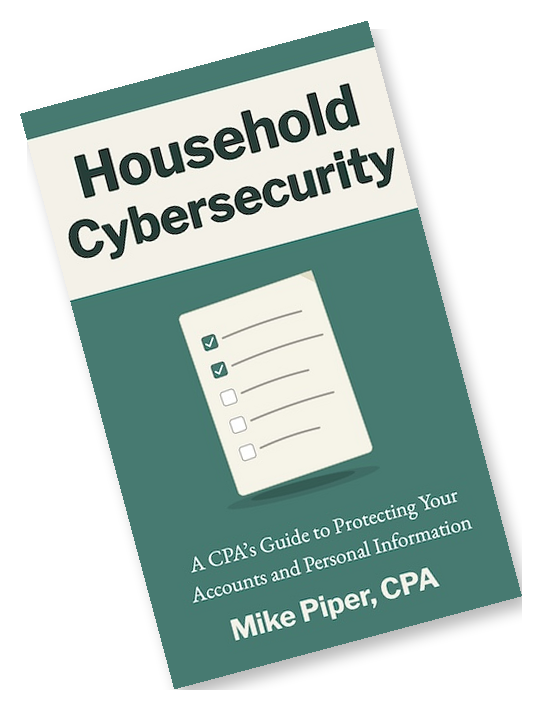
For More Information, See My Related Book:

Book6FrontCoverTiltedBlue

Household Cybersecurity: A CPA’s Guide to Protecting Your Accounts and Personal Information

Topics Covered in the Book:
  • Why passkeys and physical security keys are the biggest security upgrade most households haven't made yet.
  • How to choose and safely use a password manager.
  • The account settings, device habits, and network policies that actually reduce risk.
  • How to build a personal household security checklist, so good habits don't get abandoned.
  • What to do if the worst happens: a clear, step-by-step response plan.
  • How to help aging parents or other vulnerable loved ones, as well as a research finding that may surprise you about when to start.
  • Click here to see the full list.

Financial Planning Roundup: Social Security Trust Fund Projected Depletion Moves Closer

The Trustees of the Social Security and Medicare trust funds released their annual report this month. The big headline finding: “The Old-Age and Survivors Insurance (OASI) Trust Fund will be able to pay 100 percent of total scheduled benefits until the fourth quarter of 2032, one quarter earlier than projected last year. At that time, the fund’s reserves will become depleted and continuing program income will be sufficient to pay 78 percent of total scheduled benefits.”

Other Recommended Reading

Thanks for reading!

Asset Allocation with a Very Low Spending Rate from the Portfolio

A reader writes in, asking:

“What is your view on owning TIPS ladder (Bogleheads preferred) or short term TIPS fund when the majority of expenses are covered by pension and/or social security which are COLA adjusted.

One view I read is from Charles Ellis, who views all sources of stable retirement income (pension, social security) as bond like assets, essentially an indirect TIPS ladder.”

On the “should Social Security or a pension be treated as a bond” topic, my answer is that, no, they aren’t bonds. They are clearly fixed-income. But they are not bonds. (For a more full explanation, please see Social Security: It is an Asset, But Not a Bond.)

The case in which Social Security or an inflation-adjusted pension entirely covers spending needs is just a subset of the broader category of cases in which the household is spending at a very low rate from the portfolio in retirement. That is, for this purpose, we can lump together all cases in which a household is spending anywhere from zero to roughly 2% of the portfolio per year.

In cases like that, there is a huge range of asset allocations that would be reasonable. The household does not need high returns, so they can use a very conservative allocation. On the other hand, the volatility of an aggressive portfolio would not put their well-being at risk either, so an aggressive allocation would also be acceptable. Or anywhere in between.

In other words, at this point, it becomes entirely a matter of preferences. The retirement spending goal has been entirely satisfied. So now the question becomes:

  • Should we use an aggressive allocation, in order to increase the expected bequest to heirs?
  • Or should we use a conservative allocation, in order to not have to experience as much volatility?

Either answer is acceptable.

And because a very broad range of allocation (from highly aggressive to highly conservative) is reasonable, all the various sub-topics within the asset allocation topic become even less important.

Should this household own a ladder of individual TIPS? Sure, if that appeals to them. Or not.

Should they own a short-term TIPS fund? Again, sure, if that sounds good to them.

They could use a single LifeStrategy fund or iShares Core Allocation ETF.

Or they could use a “VT + TIPS” portfolio like I do. Or they could use a three-fund portfolio, with the bond fund being any of several different bond funds (short-term TIPS, intermediate-term TIPS, short-term nominal Treasuries, intermediate-term nominal Treasuries, a total bond fund, etc.). Or they could use any of 1,000 other more complicated portfolios, if one such portfolio appeals to them for a particular reason.

In general, when creating or assessing a portfolio, we want to be sure of five things:

  1. The portfolio is diversified (no huge allocation to a single stock).
  2. The portfolio’s risk level is appropriate for the household’s circumstances.
  3. The portfolio is simple enough to manage.
  4. The portfolio does not include anything with unreasonably high costs.
  5. The portfolio is reasonably tax-efficient.

For any given household, there are going to be many potential options that satisfy all five requirements. There is no perfect portfolio, but there are countless perfectly fine portfolios.

And specifically for a retiree household with a very low spending rate, requirement #2 on the list becomes less of a limiting factor than it often might be, so now there is an even broader range of acceptable portfolios.

Financial Planning Roundup: 2026 Edition of Taxes Made Simple

A quick announcement for today: I just released the 2026 edition of Taxes Made Simple. It includes all the stuff that’s new for 2026 (and 2025), such as the $1,000 charitable donation deduction for non-itemizers, the senior deduction, the deductions for qualified tip income, qualified overtime income, and vehicle loan interest.

If you think it would be helpful for you or a loved one, I’d encourage you to grab a copy. Or leave a review if you’ve read it in the past and found it helpful:

Other Recommended Reading

Thanks for reading!

Vanguard’s New Target Maturity Corporate Bond ETFs

In March of this year, Vanguard released a new line of Target Maturity Corporate Bond ETFs. (Prospectus here.) The line currently consists of Vanguard Target Maturity 2027 Corporate Bond ETF (VBCA) through Vanguard Target Maturity 2036 Corporate Bond ETF (VBCJ). In other words, one fund for each year, up to ten years in the future.

The funds do pretty much what you’d expect from the name:

  • Each fund holds (domestic) investment-grade corporate bonds that mature (or are expected to be called) in the year in question. For example, the Vanguard Target Maturity 2029 Corporate Bond ETF holds bonds that mature or are expected to be called in 2029.
  • Each month, the fund distributes whatever income the underlying bonds paid.
  • And then once all the bonds have matured, the fund makes a final distribution of the entire net asset value.

The idea, broadly, is that these funds could be used to create a corporate bond ladder, extending up to 10 years in the future. Vanguard even released a neat “BondBuilder Laddering Tool” to go along with the funds.

If you’re going to own corporate bonds, diversification among issuers is critical, for exactly the same reason why diversification is critical when owning stocks: you don’t want to have a disaster if any one company goes out of business.

So if you want to build a ladder of corporate bonds, using funds like these is much easier than buying individual bonds from a whole bunch of different issuers.

But do you want to build a ladder of corporate bonds?

I don’t, particularly.

To be clear, there’s nothing at all wrong with doing so. But most of the time if I’m considering a bond ladder, it’s specifically for asset-liability matching. That is, the point is the safety that a ladder can provide (due to holding bonds until maturity), relative to most funds (which maintain a steady average maturity and thus if you ever want to sell shares to raise cash, you’re always selling bonds prior to maturity). And if the goal is safety, then I specifically want the ladder to be Treasury Inflation-Protected Securities (TIPS).

Again, there’s nothing at all wrong with these funds. They’re low-cost, and I expect they’ll do a great job of doing what they say they’ll do. If you want a corporate bond ladder, these are a good choice (for up to 10 years of ladder rungs, that is).

It’s also worth noting that iShares has offered target-maturity investment-grade corporate bond ETFs since 2016. They are also low-cost and do basically the same thing. So the idea isn’t new. This is just Vanguard also offering a product in this category. (iShares also offers target-maturity ETFs of nominal Treasury bonds, TIPS, municipal bonds, and high-yield corporate bonds.)

Disclaimer: By using this site, you explicitly agree to its Terms of Use and agree not to hold Simple Subjects, LLC or any of its members liable in any way for damages arising from decisions you make based on the information made available on this site. The information on this site is for informational and entertainment purposes only and does not constitute financial advice.

Copyright 2026 Simple Subjects, LLC - All rights reserved. To be clear: This means that, aside from small quotations, the material on this site may not be republished elsewhere without my express permission. Terms of Use and Privacy Policy

My Social Security calculator: Open Social Security